Feb 5th 2026
Why LED Grow Lights for Seedlings are Important for Hydroponic Seed Starting
How important is it that young, delicate seedlings are placed under a grow light as soon as they sprout? For indoor seed starting, it’s critical. Consistent illumination causes plants to grow quicker, higher, and denser, but not all light is equally beneficial for your plants. Continue reading for our expert advice on the top grow lights for seedlings and how to utilize them to promote hardier fruits and vegetables.
Benefits of Using a Seedling Grow Light
In addition to giving growers an earlier start to the season, using grow lights for seedlings increases the hardiness and developmental consistency of any crop. It can help control the seed-to-harvest timeline and improve the predictability of your grow cycle.
Adding grow lights to your repertoire for seed starting has the additional benefit of allowing the fixtures to continue operating as a mainstay of your grow, until the seedlings are ready for transfer into the hydroponic system.
Why do Seedlings Need Grow Lights?
Young plants require intense light throughout their early growth phases in order to generate robust stems and healthy root systems. Insufficient light makes it difficult for seedlings to grow healthily and increases the likelihood that they won't survive transplanting.
When seeds first sprout, the seedlings are like babies starving for food. The seedlings need light immediately to kickstart the photosynthesis process. If lighting is late or inadequate, their stems will stretch out pushing the plant upward looking for light. If the stems stretch too far, they will get too tall and too skinny – unable to hold the weight of the plant canopy. They will become top heavy and wilt over to the side. This is known as becoming “leggy.”
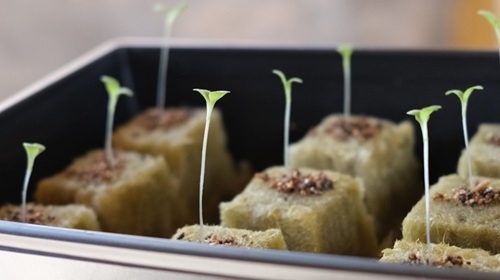
"Leggy seedlings" are nearly impossible to recover when using hydroponic systems. When growing with soil, it's possible to save leggy seedlings by “potting up.” This means you bury the plant deeper into the soil, so the soil helps stabilize the skinny stems and help them stay upright. But since hydroponics does not use soil, potting up is not possible. Leggy seedlings must be discarded, and the germination process must start over by re-planting seeds.
You can avoid leggy seedlings by using a grow light with your seed starting. The key is to move your seedlings under the grow light as soon as they sprout. These lights offer a steady and regulated light source, in contrast to sunlight - which might change depending on the season, time of day, or the cloudiness outside.
More significantly, they provide certain lighting wavelengths that promote both photosynthesis and a process called photomorphogenesis, particularly in the blue and red ranges. This is how plants use light signals to modify their general structure, stem thickness, and leaf growth.
How to Use Grow Lights for Starting Seedlings
LED grow lights for seedlings allow you to nurture your baby plants until their ready to be transferred into your hydroponic system. Healthy seedlings result in healthy mature plants. This allows you to provide fresh and hearty food to your family's table, whether it's a seasonal nursery or a year-round hydroponic garden.
Light Intensity
The brightness of light is known as its intensity. A bulb's light output may be measured in a number of ways but sadly, two distinct bulbs may provide differing light output values, making comparisons challenging. The intensity of light is also affected by the distance between the plant and its light source.
Distance from the Light Source
When utilizing bulbs that generate a lot of heat, such as incandescent and high-pressure sodium bulbs, it's especially crucial to maintain enough space between plants and a light source.
However, with the prevalence of LED lighting these days one of the big advantages is they run very efficiently – which means they are relatively cooler than other light sources. With LED lights, bring your light as close as you can to the light canopy, without burning the plant. Generally, this is about 2 to 4 inches depending on the strength of your LEDs. The light should be shifted away from the plants if you notice yellow, brown, or dry areas on the tips of the leaves.
Light Quality
The wavelength or color of light is referred to as its quality. Red, orange, yellow, green, blue, indigo, and violet light make up the light spectrum. All these hues of light are produced by natural sunlight. Photosynthetically Active Radiation (PAR), which is mostly made up of red and blue light, is the portion of the light spectrum that plants employ. Seedling grow lights that generate light from the red and blue wavelengths of the light spectrum have shown to accelerate plant growth. Before purchasing a grow lamp, check the specifications to find out what kind of light it emits. Grow lights are typically branded as blue, red, or white/balanced light.
Light Duration
The number of hours of light that a plant requires in a 24-hour period is known as light duration, or photoperiod. For blooming response, plants are divided into three groups based on photoperiod: day-neutral, long-day, and short-day. As a rule of thumb we recommend starting with a photoperiod of 12 – 16 hours a day and adjust from there as needed.
Types of Grow Lights for Seedlings
LED Lights
As the main focus of this article, Light Emitting Diodes (LED) have become more and more popular because of their long life, energy efficiency, and adaptability. Growers are able to customize the light spectrum to suit certain plant needs because LED grow lights can be tailored to specific wavelengths. They are adaptable to various growth phases and generate less heat, lowering the possibility of burning fragile seedlings.
Fluorescent Lights
For seed starting, T5 and Compact Fluorescent Lights (CFL) are other options. They are reasonably energy-efficient and produce a balanced spectrum of light appropriate for different stages of plant growth. CFL bulbs are a great option for novices since they are accessible and reasonably priced. T5 fluorescent lights are perfect for bigger seedling trays since they have a higher intensity.
High Pressure Sodium (HPS) Grow Lights
Because they provide high-intensity light that is perfect for fruiting and blooming plants, HPS lamps are widely used in hydroponic container farms. HPS lights provide a reddish spectrum that helps generate blooming and fruiting. However, they require adequate ventilation and cooling systems since they produce more heat and energy. They are also a lot more expensive than LEDs, making them less and less popular.
How to Set Up Grow Lights for Seedlings
- To promote both photosynthesis and photomorphogenesis in the early stages, use full-spectrum or a mix of blue and red wavelengths.
- The grow light should be positioned 5 to 10 cm (2 to 4 inches) above the plant canopy. To maintain ideal intensity without putting the seedlings under heat stress, adjust the height as they become bigger.
- Most seedling varieties require 12 to 16 hours of light each day. A consistent photoperiod is necessary for healthy growth and root development. You can use a timer to help automate the on / off cycle of your grow light.
- Ensure that every seedling receives the same amount of light. If the covering of your seedling grow light is uneven, rotate the trays or individual plants periodically to prevent lanky or stunted development in certain areas.
- Maintaining a well-ventilated space helps avoid overheating and lowers the chance of fungal problems like damping-off, even with low-heat lighting like LEDs.